

The investor has become the center of the real estate market, and the financing is changing with them.
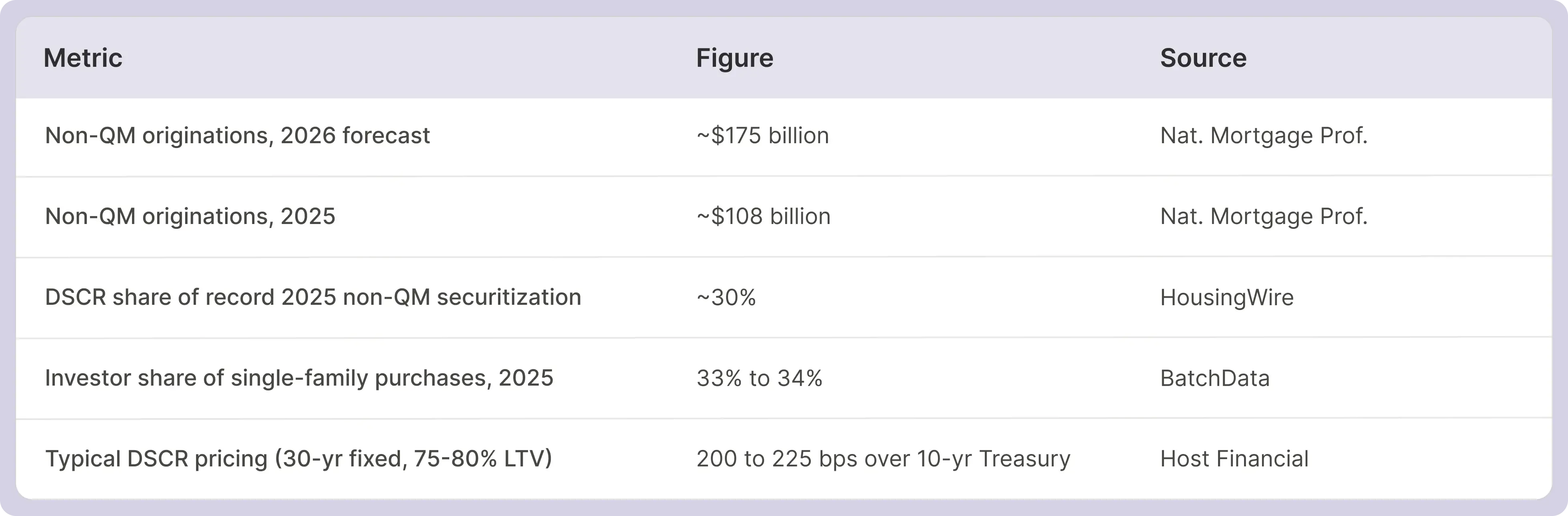
Real estate investors purchased between 33% and 34% of all single-family homes sold in the United States in 2025, the highest investor share in five years. As more properties move into the hands of professional investors building rental portfolios, the limitations of traditional personal-income underwriting become harder to ignore.
DSCR lending is built for that shift. Instead of qualifying a borrower primarily on personal income, a DSCR loan qualifies the property on its ability to service its own debt. That makes it possible for an investor to keep acquiring properties without running into the personal debt-to-income ceiling that eventually stops conventional financing.
The numbers are not subtle
Non-QM originations, the category DSCR sits inside, are forecast to reach roughly $175 billion in 2026, up from about $108 billion in 2025. DSCR and other investor products are expected to account for about half of all non-QM collateral, while DSCR loans made up roughly 30% of record 2025 non-QM securitization.
This is not a rate-cycle trade that disappears when borrowing costs fall. It is a structural shift in who is buying property, how they finance it, and what they expect from the lenders financing their portfolios.
For private lenders, that creates a more important question than whether DSCR volume is growing: are you building an operation that can keep the DSCR borrower as they scale?
The growth is structural, not cyclical
The easy explanation is that high rates pushed borrowers toward alternative products, and lower rates will eventually pull them back, but that sentiment is oversimplified.
Two forces are driving DSCR demand, and neither unwinds quickly with the rate cycle.
The first is the lock-in effect. Millions of homeowners hold mortgages at pandemic-era rates far below anything available today, and many have little reason to sell into a higher-rate market. That keeps for-sale inventory tight and pushes more housing demand toward rentals—the exact collateral DSCR finances. Even if rates ease, the gap between a 3% legacy mortgage and a 6% new one is large enough to keep the effect in place for years.
The second is the shape of income. A growing share of borrowers earn through self-employment, business ownership, or other nontraditional structures that conventional debt-to-income underwriting handles poorly. A borrower with strong assets and uneven income can be denied a conventional loan and approved for a DSCR loan on the same property because DSCR asks a different question: can the property pay for itself?
There are more investors in the market, and more of them don't fit neatly into conventional underwriting. DSCR was built for both.
That is why the product's trajectory looks less like a temporary response to rates and more like a permanent feature of investor finance.
What the product does, and why it scales
The mechanics explain the demand. A DSCR loan qualifies on the debt-service-coverage ratio: the property's rental income divided by its debt payment. A ratio above 1.0 means the property covers its own financing. Because qualification rests on the asset rather than the borrower's personal balance sheet, an investor can keep acquiring without hitting the personal debt-to-income ceiling that stops a conventional borrower after a handful of properties.
That is the feature that turns a single loan into a portfolio strategy. An investor who wants to hold twenty rentals cannot get there on conventional financing, because every loan counts against personal DTI until a bank says no. DSCR removes the ceiling. Pricing reflects the added risk, running a spread of roughly 200 to 225 basis points over the 10-year Treasury for a standard 30-year fixed at 75% to 80% loan-to-value, but for an investor building a book, access matters more than a fractional difference in rate. The full mechanics of how DSCR is calculated and underwritten are covered in our dedicated DSCR guide.
The bridge-to-DSCR pathway is feeding the pipeline
DSCR volume does not come only from investors buying stabilized rental properties. A significant part of the pipeline begins with the short-term lending that comes first.
An investor buys a distressed property with a bridge or fix-and-flip loan, renovates it, stabilizes it with a tenant, and then refinances the short-term debt into a long-term DSCR loan once the property produces income.
The bridge loan gets the deal done. The DSCR loan makes it a keeper.
That connection matters for private lenders because the DSCR refinance is often the natural next step in a relationship that already exists. Every active fix-and-flip and bridge lender is therefore feeding future DSCR demand, whether or not they originate the refinance themselves.
A lender that writes the bridge loan and then hands the DSCR refinance to a competitor is funding that competitor's pipeline with its own borrower.
The opportunity is bigger than adding another product to the rate sheet. It is keeping the borrower through the next stage of their investment strategy.
What the surge demands of a lender
This is where the trend stops being market color and becomes an operational question.
The DSCR borrower is different from the one-off investor taking out a single fix-and-flip loan. They are often building a portfolio, which means the relationship compounds with every successful transaction—and becomes easier for a competitor to capture every time the experience breaks down.
Serving that borrower requires underwriting built around rental income and property cash flow, the ability to move quickly when a bridge loan is approaching maturity, and clean records across a growing book so that the tenth deal is easier to manage than the first.
None of that is especially difficult in principle. However, it gets much more complicated at volume on manual systems.
A lender chasing rent rolls through email threads and tracking a dozen loans for the same borrower across separate spreadsheets will eventually lose that borrower to the lender who can see the entire relationship in one place and move the next refinance through in days.
The DSCR surge rewards operational capacity as much as it rewards having the product on the rate sheet.
DSCR is growing up and the rules are changing
DSCR is leaving its early phase. Industry figures describe the product moving out of a wild-west period of loose, inconsistent underwriting toward standardized criteria and better data, a shift captured in trade coverage like Nema Daghbandan’s "DSCR Tightens Its Grip" in Private Lender.
Standardization is good news for lenders who already run disciplined operations and a problem for those who compete on the loosest terms available. As underwriting firms up and institutional capital demands cleaner collateral, the lenders who documented well and underwrote consistently get the cheaper capital and the repeat borrowers. The lenders who won deals by asking the fewest questions will find the market has moved past them.
DSCR at a glance
The figures behind the DSCR surge, 2025 to 2026.
The bottom line
DSCR is becoming a core part of the investor lending relationship, from the bridge loan that starts a deal to the refinance that turns it into a long-term hold. Baseline gives private lenders one system to manage that full arc as their borrowers—and their portfolios—grow.
The product gets you into the relationship. The operation determines whether you keep it.
See how Baseline supports the full lifecycle of private lending: baselinesoftware.com/contact-us