

Private Lending Is Growing. So Why Is It Getting Harder to Compete?
The margins are getting tighter. Borrowers expect faster closings. Institutional capital is moving deeper into the market. And demand for products such as residential transition loans and DSCR financing continues to accelerate.
It’s an evolving recipe, shaped by a market that is becoming less forgiving.
Yet the lenders pulling ahead are not necessarily the ones charging the highest rates or doing the most deals. They are the ones that can underwrite precisely, move quickly, manage risk across a growing portfolio, all while giving capital partners clean, reliable data.
In this report, we examine the data behind the 2026 private lending market, including where loan volume is growing, how borrower behavior is changing, where institutional capital is moving, and why operational infrastructure is becoming a competitive advantage for private lenders.
Margins fell, activity rose, and both are signals
The clearest picture of the year comes from the fix-and-flip market, where the data is cleanest and the operators are most exposed.
Gross returns on flipped homes fell to roughly 23% in the third quarter of 2025, the lowest reading since 2008, according to ATTOM Data Solutions. Annual flip volume slid from 407,417 properties in 2022 to 297,045 in 2025. Read in isolation, those two numbers describe a market in retreat.
The behavior of the people closest to the deals says the opposite. In a survey of active flippers by John Burns Research and Consulting and Kiavi, 71% said they expect to buy more properties in 2026 than they did in 2025, the highest share in the survey's four-year history. ATTOM's first-quarter 2026 report put numbers behind the sentiment: 64,348 properties flipped, about 8% of all residential sales, with gross returns rising to 25.4%, the first quarterly increase in nearly two years.
A market where returns compress and committed operators lean in is not confused. It’s filtering.
Thinner margins punish imprecision, and the investors still active are the ones who can make money at a 25% gross return instead of the 40% the last cycle handed out for free. They are not waiting for the market to give them a margin. They are building one deal at a time, through underwriting.
The national average also hides how wide the spread has become. In the second quarter of 2025, gross returns topped 107% in Pittsburgh and 109% in Buffalo, while Cleveland climbed from 39% to 72% in a single year, according to ATTOM. Those markets share a structure: low acquisition prices, stable employment anchors, and constrained new construction that keeps resale inventory tight. Florida and Texas metros, still working through the inventory the construction wave left behind, are handing flippers longer holds and thinner exits. The averages describe a country. Lenders underwrite a zip code.
That distinction runs through every segment of private lending this year.
The market that matters is bigger than most lenders think
Private credit as an asset class gets constant coverage, and most of it describes a business that a fix-and-flip or DSCR lender would not recognize. The widely cited figure of private credit reaching $5 trillion by 2029 refers to institutional corporate direct lending, a separate market with different borrowers, different deal sizes, and different mechanics. Borrowing that number to describe real estate private lending overstates the case and invites the first sharp question from anyone who knows the difference.
The number that describes this market is residential transition lending. In 2025, lenders originated more than $85 billion in residential transition loans, including over $25 billion for ground-up construction and more than $35 billion to renovate existing housing, according to the Urban Institute. Residential transition loans are the current name for what the industry spent decades calling hard money: short-term, asset-based, business-purpose loans on properties a bank will not finance.
The renaming tracks a real shift in the capital behind these loans. The National Private Lenders Association moved to retire the term hard money in favor of private lending and bridge lending, and the language followed the money. A market that institutional investors underwrite at scale does not keep a name that sounds like a loan made in a parking lot.
Rates came down, and speed became the product
For two years, the first thing anyone said about a private loan was its rate. Hard money sat in the double digits, and price led every conversation.
That pressure has eased. Premier borrowers with a track record are seeing hard money rates between 8.5% and 11.25% as of the second quarter of 2026, down from the double-digit floors of 2023 and 2024. On the long-term side, DSCR loans price at a spread of roughly 200 to 225 basis points over the 10-year Treasury for a standard 30-year fixed at 75% to 80% loan-to-value.
As pricing settled, the basis of competition moved with it. Investors increasingly choose a lender on certainty of close rather than a 50-basis-point difference in rate. A lender who funds in a week beats a lender who quotes a quarter-point less and takes three, because in a competitive acquisition the deal that closes is worth more than the deal that prices well.
Speed, in this market, is an operational capacity. It is built or not built long before a specific deal walks in the door, and it cannot be quoted into existence at the closing table.
Where the volume is going: the DSCR surge
The fastest-moving segment of the market is the loan that lets an investor keep buying.
DSCR loans, which qualify a borrower on a property's rental income rather than personal income, have moved from a niche product to a structural feature of investor finance. Non-QM originations, the broader category DSCR sits within, are forecast to reach roughly $175 billion in 2026, up from about $108 billion in 2025, with DSCR and other investor products expected to make up about half of all non-QM collateral. Non-QM securitization hit a record in 2025, and DSCR loans accounted for roughly 30% of that volume.
This is not a rate-cycle artifact. Real estate investors bought between 33% and 34% of all single-family homes sold in the United States in 2025, the highest investor share in five years. Those buyers need financing that scales with a portfolio instead of stalling against personal debt-to-income limits, and DSCR is the product built for exactly that.
The durability comes from structure. Millions of homeowners are locked into low pandemic-era mortgage rates and will not sell, which keeps supply tight and rental demand high. There is also a growing share of borrowers earning through self-employment or nontraditional income that conventional underwriting handles poorly. DSCR speaks to both conditions. It qualifies the property rather than the pay stub, which is why industry analysts describe its rise as a structural response to a high-rate environment rather than a passing trend.
The DSCR story is significant enough, and moving fast enough, to warrant its own treatment in a companion piece. For the market picture, the takeaway is short: the investor who used to be a borrower is now the center of the market, and the products are reorganizing around that.
Institutional capital is in the building
The clearest sign that private lending has institutionalized is knowing who buys the loans after they close.
Residential transition loan securitization grew from roughly $7 billion in 2024 to about $8 billion in 2025, and rating agencies that ignored the sector for years are now rating deals. Institutional money is moving deeper into the loans that finance renovations and residential construction, which changes the economics for everyone who originates them.
For a local lender funding off a balance sheet, that cuts two ways. Reliable secondary-market execution means more available capital, but also more competition and more pressure on pricing. It also raises the bar. Institutional buyers expect clean data, consistent underwriting, and documentation that survives a rating agency's review. Lenders who produce that get access to cheaper capital. Lenders running on spreadsheets and memory get left holding the loans nobody wants to buy.
The professionalization gap is the whole story
Every thread in this report ties back to the same knot. Compressed margins, faster closings, institutional capital, portfolio-scale borrowers: each one raises the operational bar, and each one raises it for the same reason.
The lenders growing in 2026 share a profile. They underwrite conservatively in a market that still talks loose. They model 120 to 150 days of carry time instead of assuming everything goes right in 90. They are selective about geography, favoring the supply-constrained secondary markets where the math still works over the oversupplied Sun Belt metros where it does not. They treat a rehab budget as something to interrogate line by line, not a number to accept.
None of that holds up on a spreadsheet at scale. It requires systems: a pipeline that surfaces a stalled draw before it becomes a loss, servicing that flags an exception the day it happens, capital reporting an institutional partner can trust without a follow-up call. The discipline the market now rewards is operational discipline, and operational discipline runs on infrastructure.
This is the professionalization gap. It is the distance between lenders who have built an operation and lenders who are still running a pile of individual deals. In 2026, that gap is what decides who keeps growing.
The technology inflection
The infrastructure question stopped being theoretical, because the tooling caught up to it.
The loan origination software market is projected to reach $9.1 billion by 2030, growing at about 10.5% a year from 2024. Most private lenders starting up in 2026 default to cloud software rather than building their operation on spreadsheets and disconnected point tools. The logic is plain: with a new generation comes a higher operational bar to clear leaving an ever widening gap a business built on spreadsheets will need to make up for.
Lenders moving off manual processes are not chasing trends in efficiency for its own sake. They are securing the ability to underwrite precisely, close quickly, service cleanly, and report credibly, which is the exact set of capabilities this market pays for. Technology adoption in private lending has moved from a back-office decision to a competitive one.
What to watch heading into 2027
The forces shaping 2026 point somewhere specific.
Housing supply is the variable to track. Multifamily and single-family construction pipelines have contracted sharply, and several analysts expect parts of the country to move from oversupplied to undersupplied by 2027. A supply shortage would tighten the resale and rental markets that fix-and-flip and DSCR lending depend on, which favors the lenders positioned to move the moment it turns.
DSCR itself is maturing. Industry voices describe the product moving out of its wild-west phase toward standardized underwriting and better data. Standardization pulls in more institutional capital and more competition, and it rewards the lenders already running disciplined operations.
The through-line for 2027 is the same one that defined 2026. The market is getting bigger, more institutional, and less forgiving of imprecision. That is good news for the operators who built for it, and a warning for everyone else.
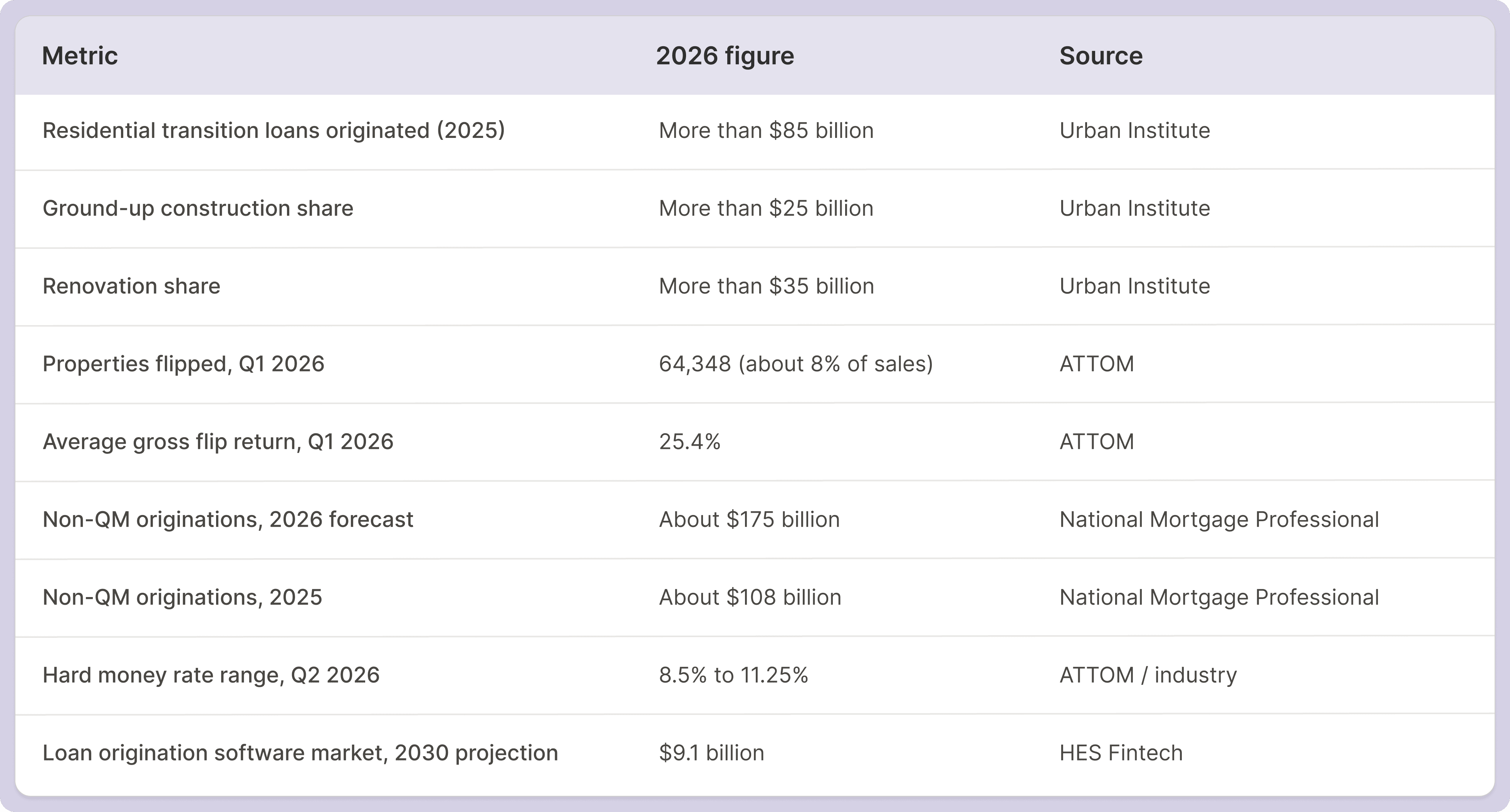
Private lending by the numbers, 2026
A snapshot of the figures anchoring this report.
The bottom line
Private lending in 2026 is a market growing up, and growing up means the standards rise. Margins reward discipline. Borrowers reward speed. Capital rewards clean operations. Each of those is an operational capability before it is a competitive advantage.
The lenders who will define the next stage of this industry are building the operation now, while the market is still filtering. Baseline was built for that exact work, carrying a lender from origination through servicing and capital operations in one system.