

Choosing a loan origination system is one of the most consequential infrastructure decisions a private lender makes. The platform you select will touch every loan you originate, every payment you process, and every investor statement you generate — for years. Get it right and the operational complexity of running a private lending business becomes manageable at scale. Get it wrong and you spend the next several years building workarounds for things the platform was never designed to handle.
The evaluation is harder than it looks. Most platforms demo well. The interface is clean, the rep knows the workflow, and the scenarios are chosen to show the system at its best. What a 45-minute demo rarely reveals is whether the platform correctly handles the mechanics that define private lending: product-level interest calculation configuration, non-Dutch draw accrual, maturity date extensions, split-period loan modification recalculation, investor capital management. Those are the capabilities that determine whether the platform works in practice — and they are exactly what this guide is built to help you evaluate.
The US private lending market originated approximately $121 billion in business-purpose real estate loans in 2025, up roughly 25% year over year from $97 billion in 2024, according to SFR Analytics. Non-QM securitization volume reached a record high in 2025, with DSCR loans — a product that barely existed at scale a decade ago — comprising roughly 30% of that total, according to HousingWire. The operators evaluating software today are doing so in a market that has professionalized rapidly. The platforms targeting them have not all kept pace. This guide explains how to tell the difference.
Why Private Lending Requires a Different Kind of LOS
Most origination platforms are built for conventional residential lending: W-2 income verification, standard 30-year amortization, regulated consumer products with predictable payment structures. Private lending is structured differently at every level — shorter terms, interest-only periods, construction draw schedules, non-standard amortization, maturity date extensions, asset-based underwriting, and in many cases, capital deployed from investors rather than a balance sheet.
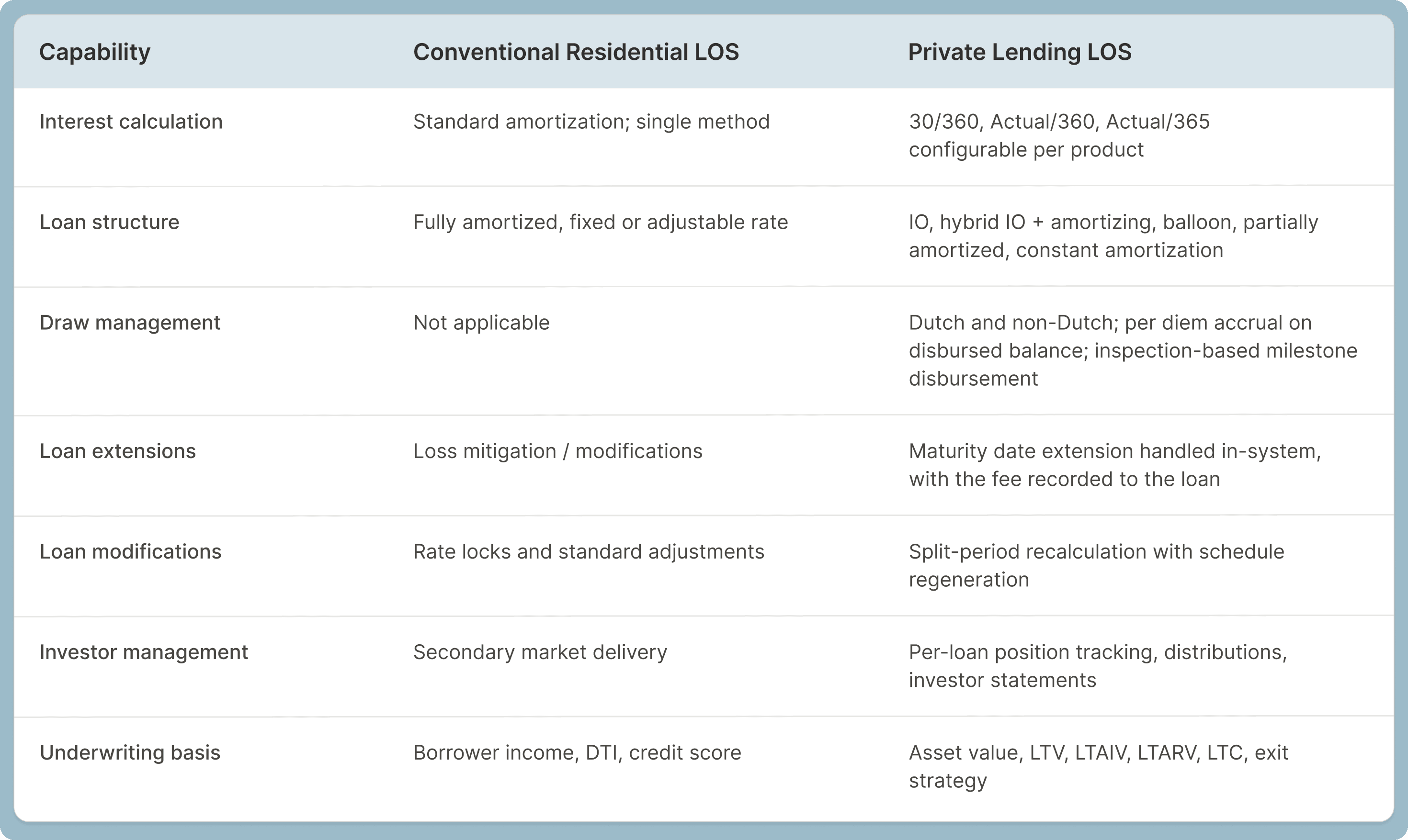
A platform that cannot configure 30/360 versus Actual/360 interest correctly, handle Dutch versus non-Dutch draw accrual, process a maturity extension and record the fee to the loan, or generate an accurate amortization schedule for a hybrid IO plus amortizing DSCR loan is not fit for purpose — regardless of what the demo looks like. The table below compares typical conventional residential origination platforms against platforms built for private lending. It is not a criticism of conventional platforms — they do what they were designed to do. The problem arises when a private lender selects one because it is familiar or inexpensive, then spends years building workarounds for everything it cannot handle natively.
Six Criteria to Evaluate in Any Private Lending LOS
Feature lists are long. Vendor decks are longer. The six criteria below are the ones that determine whether a platform will actually work for your portfolio — not whether it looks good in a 45-minute demo. Each one names a specific capability, explains why it matters in private lending specifically, and describes what it looks like when a platform handles it incorrectly.
This guide is the evaluation framework. The private lending software features checklist pairs with it as a line-by-line scorecard.
1. Loan Product Configuration
This is the most important criterion in the evaluation because it requires a level of technical specificity that most platforms would prefer to avoid.
Private lending usually uses three interest calculation methods: 30/360, which normalizes every month to 30 days and every year to 360; Actual/365, which uses real calendar days divided by 365; and Actual/360, which uses real calendar days divided by 360. Each is a legitimate choice for specific products and purposes — the question is not which method a lender uses but whether the platform enforces that choice consistently. A misconfigured product-level setting on a $10,000,000 portfolio at 8% produces a calculation gap of approximately $11,111 per year between the two Actual methods — a difference that is invisible on any individual loan and only surfaces when portfolio yield is compared against projections.
The configuration question is not just which methods the platform supports. It is whether those methods can be assigned at the product level, so that every loan originated under a given product — DSCR, fix-and-flip, bridge, construction — inherits the correct setting automatically. A platform that requires per-loan configuration introduces the risk of inconsistency across originations. A platform that defaults every product to a single global setting cannot serve a mixed portfolio correctly.
The same logic applies to per diem basis for irregular periods, amortization type — including hybrid IO plus amortizing structures that transition mid-term and reach zero by end of loan term without a balloon — and fee structure. Origination, extension, exit, draw, and inspection fees should all be configurable at the product level and automatically posted to the loan ledger. These are not advanced features. They are the baseline configuration decisions that determine whether the platform produces correct numbers from day one.
2. Construction Draw Management
For any lender originating fix-and-flip or construction loans, draw management is the highest-complexity operational workflow in the business. It is also the area where generic platforms most commonly fail private lenders, because the mechanics are specific to this asset class and rarely appear in conventional LOS design.
The core capability is non-Dutch interest accrual: interest charged only on funds that have been disbursed, not on the full committed loan amount. On a $500,000 construction commitment where $200,000 has been released, interest accrues on $200,000 only. When the next draw of $75,000 is approved and released mid-period, the platform must automatically calculate per diem interest on that $75,000 for the remaining days in the period and add it to the current billing period's total — without manual input from the lender's team.
Beyond accrual accuracy, draw management requires a full disbursement workflow: the ability to track draw requests, route them for approval against a budget, and maintain real-time visibility into the remaining draw balance. For lenders using inspection-based draw schedules — standard in private construction lending, where disbursements are tied to verified completion milestones — the platform should support milestone tracking tied to disbursement approvals.
Ask any platform you evaluate to demonstrate this with a specific scenario rather than a description. A lender closes a $400,000 fix-and-flip loan on the 10th. A draw of $60,000 is approved and released on the 19th. What does the interest charge look like for that period? How does the platform calculate it, and where does it appear in the loan ledger? The answer reveals more than any prepared walkthrough.
3. Borrower and Broker Portal
Private lending competes on speed. The average purchase mortgage closed in 36.8 days in March 2026, according to ICE Mortgage Technology — the fastest average on record. Many private lenders close in 10 to 14 days, and some close in under a week. That speed advantage is partially operational — and a lender whose borrowers submit documents by email, request draws by phone, and wait for manually generated payoff statements is giving back a portion of that advantage on every loan.
A functional borrower portal allows borrowers to submit applications digitally, upload required documents, track loan status in real time, submit draw requests with supporting documentation, and view payment history without calling the office. It should be branded under the lender's identity, mobile-responsive, and accessible without requiring the borrower to download a separate application. Private lending also attracts repeat borrowers — real estate investors return to lenders who make the process frictionless. The portal experience is part of what drives that retention.
For lenders who source deals through brokers or referral partners, a broker portal matters for the same reasons. Brokers who can submit deals, track their pipeline, and receive status updates without involving the lender's staff are more productive and more likely to send repeat business. In markets where the same broker is working with several lenders simultaneously, the quality of that experience is a competitive signal.
4. Servicing and Payment Processing
Servicing is where the configuration decisions from criteria one through three either hold or expose themselves. A platform that calculates interest correctly at origination but cannot handle a mid-period modification, generate an accurate payoff statement on demand, or process payments automatically has solved the easier half of the problem.
Automated payment processing means ACH processing with configurable payment application order — most private lenders apply payments to interest first, then principal, then fees, but this should be configurable rather than hardcoded. Late fee calculation and posting should be automatic, tied to the payment due date and the grace period configured at the product level.
Payoff statement generation is a daily operational requirement for any active portfolio. A platform that requires manual calculation for payoffs, or that can only generate a statement as of a scheduled due date rather than an arbitrary future date, creates a bottleneck that grows with loan volume.
Loan modification handling deserves particular attention. When a rate or principal changes mid-period, the platform must split the billing period, calculate interest at each rate for the correct number of days, and regenerate the amortization schedule from the modification date forward. Platforms that record the modification but do not automatically recalculate produce an incorrect schedule from that point.
Maturity date extensions are a standard feature of private lending — three-to-six month extensions are common across bridge, fix-and-flip, and construction loans when a project needs additional time to reach sale or refinance. The platform should let you process an extension in-system rather than tracking it on the side: update the maturity date, add the extension fee, and have that fee recorded against the loan. What matters is that the extension and its fee live in the system of record — extensions tracked manually outside the platform create the same audit and reconciliation problems as any other unlogged change.
5. Capital and Investor Management
Most private lenders deploy capital from investors — whether a small group of high-net-worth individuals or capital partners with more structured arrangements. Managing investor positions, calculating returns, and distributing proceeds in a spreadsheet works at two or three investors. It becomes unreliable at ten and operationally fragile beyond that.
A platform with native investor management tracks investor positions per loan, calculates returns based on configured investor terms, manages the distribution workflow, and generates investor statements without requiring a separate process outside the system. An investor portal that gives capital partners self-service access to their positions and distribution history reduces inbound communication volume and signals operational maturity.
This capability varies more significantly across platforms than any other criterion on this list. Some treat investor management as a core feature. Others offer it as a bolt-on module with limited functionality. A few do not support it at all. Evaluate this based on where your capital structure is headed, not just where it is today — and confirm specifically what the platform supports before signing. Most platforms that support investor capital handle the fundamentals: tracking fund balances, recording deposits and withdrawals, and deploying capital into loans. Structured-fund mechanics are a separate tier — capital call processes, preferred return calculations, and waterfall distributions are far less common and should be tested directly if your operation runs on them.
6. True Cost of Ownership
Monthly subscription pricing is almost never the full cost of a loan origination system. The gap between the quoted monthly rate and the actual 36-month cost is where most evaluation mistakes happen, and where platforms that look similar in a demo reveal themselves to be quite different.
A complete cost picture includes the base subscription fee, per-loan or per-user pricing at scale — many platforms are inexpensive at 30 loans and significantly more expensive at 150 — module costs for capabilities sold separately, implementation fees, data migration costs, training, and ongoing support tier. Servicing, investor management, and borrower portal are commonly bundled or priced separately depending on the platform and the plan.
Request a 36-month cost projection at your current loan volume and at two or three projected growth scenarios. Platforms that quote only monthly pricing without projecting at scale are withholding the information you need to make a sound comparison.
Data portability belongs in this conversation. If you decide to leave the platform, or if an institutional capital partner requires a full loan data export for due diligence, can you retrieve your complete loan history in a usable format without a support ticket or an additional fee? Test data export during the evaluation, not after signing. Platforms that make it difficult are pricing switching costs into the relationship from the start.
What to Ask During a Private Lending Software Demo
- Every loan origination platform looks capable in a prepared demo. The rep knows the workflow, the sample data is clean, and the scenarios are chosen to show the system at its best. The questions below are designed to move outside the prepared script and reveal how the platform actually handles the mechanics that define private lending. Ask for live demonstrations of each — not a description of how the feature works in theory, but a walkthrough of the actual configuration or workflow.
- "Show me how you configure a fix-and-flip loan product with non-Dutch interest on draws. Walk me through the actual product setup, not a sample loan."
- "A borrower closes on the 14th of the month. Show me how the system calculates the opening period — the per diem charge and the first full payment date."
- "We change a borrower's rate on the 18th of the month. Show me how the system handles the split period and what happens to the amortization schedule from that point forward."
- "A borrower needs a 3-month extension. Walk me through how the platform processes that — the maturity date update, the extension fee, and what happens to the payment schedule."
- "Generate a payoff statement for a loan with an outstanding draw balance, as of a date 12 days from now. Show me where the per diem is calculated and how the draw balance is reflected."
- "What does a full data export look like? Pull the complete loan history for a sample loan and show me the format it comes out in."
- "What does your support structure look like 18 months after implementation — not during onboarding?"
The platform's ability to answer these questions directly — without escalating to a technical team, without scheduling a follow-up call — is itself a signal. Platforms built for private lending should handle these scenarios without hesitation because they are standard operating requirements for the lenders they serve.
Red Flags to Watch for During a Platform Evaluation
The following are specific signals worth noting during any platform evaluation. None are automatically disqualifying, but each warrants a direct follow-up before moving forward.
- The demo uses sample data only and the rep cannot demonstrate your specific loan products or configurations in the session.
- Interest calculation method is described as "standard" or "industry-standard" without specifying 30/360, Actual/360, or Actual/365. These are meaningfully different and should be named.
- Construction draw interest accrual is described as "flexible" or "fully configurable" without a live demonstration of how a mid-period draw affects the current period's interest charge.
- Loan extensions are tracked outside the platform — the maturity change and any fee live in a spreadsheet or side note instead of in the loan record.
- Pricing is quoted monthly without a 36-month projection at scale. Additional modules for servicing, investor management, or borrower portal are not disclosed upfront.
- Data export is described as "available" but requires a support ticket, a processing window, or an additional fee. Self-service data access should be standard.
- Implementation timeline is described as simple or quick for a full portfolio migration without specifics on who prepares the data for import, who validates that balances transferred correctly, and what the resolution process looks like if imported data produces errors after go-live.
- The platform cannot demonstrate a loan modification with split-period recalculation in the demo environment.
How to Match a Platform to Your Portfolio Stage
Not every private lender needs every capability on day one. The right platform depends on your product mix, your capital structure, and your growth trajectory. The six criteria above apply at every stage — but the weighting changes. These thresholds are rough guides; a lender managing a single product type will generally hit operational limits later than one running DSCR, construction, and bridge simultaneously.
Early-Stage Operators (Under 30 Loans)
Loan product configuration, basic servicing automation, and accurate per diem calculation are the priorities. A borrower portal reduces friction from day one and is worth including in the evaluation even if it is not immediately essential. Investor management and advanced reporting can follow. At this stage, implementation simplicity and the ability to self-configure loan products without technical support matter more than enterprise-grade features that will not be used for years. Confirm in writing what the platform costs at 50 and 100 loans before signing at 20.
Mid-Stage Operators (30 to 150 Loans)
Full servicing automation becomes critical. Manual payment processing and extension handling at this volume absorbs enough staff time to justify software on the labor cost alone. Draw management quality matters if any portion of the portfolio is construction or fix-and-flip. Investor management should be evaluated seriously if bringing on additional capital partners is on the roadmap — confirm what the platform actually supports before assuming fund structure capabilities are included.
Scale-Stage Operators (150-Plus Loans, Institutional Capital)
Every criterion on this list is non-negotiable. Investor reporting and capital management are operational requirements. Integration with accounting systems and CRM becomes a priority as the operation professionalizes. Portfolio analytics — yield by product, delinquency by vintage, maturity pipeline — are necessary for the reporting that institutional capital partners expect. At this stage, the cost of switching platforms is high enough that getting the evaluation right from the outset is worth significantly more time and scrutiny than earlier-stage operators typically invest.
Frequently Asked Questions
What is the difference between a loan origination system and loan servicing software?
A loan origination system manages the loan creation process — application intake, underwriting, document generation, and closing. Loan servicing software manages the loan after closing — payment processing, interest accrual, draw management, investor reporting, and payoff. Some platforms cover both in a single system; others specialize in one and integrate with a partner for the other. For most private lenders, a single platform handling origination through payoff is operationally simpler and reduces the risk of misconfiguration at the handoff between systems.
How long does it take to implement a private lending LOS?
Implementation timelines vary significantly by platform and by the complexity of the migration. For operators moving from spreadsheets, the primary work is preparing loan data for import and validating outputs afterward — a process that can take anywhere from a few weeks to a couple of months depending on portfolio size and data quality. Migrating from a competing platform takes longer if data export from the prior system is limited. Ask any platform you evaluate for a specific implementation timeline based on your loan count, product mix, and current data format — and ask for a reference from a lender who migrated from a comparable setup.
What does private lending LOS software typically cost?
For operators managing between 20 and 200 loans, most purpose-built private lending platforms are typically priced between $300 and $1,500 per month at base. That range reflects significant variation in what is included: some platforms bundle origination, servicing, borrower portal, and investor management; others price each module separately. Request a 36-month projection at your current and projected loan volume before comparing monthly rates — platforms that look similar at $500 per month can diverge substantially at 150 loans.
Can a general mortgage LOS work for private lending?
For simple portfolios with a single product type and standard amortization, a general LOS can work with configuration effort. For portfolios that include construction draws, interest-only bridge loans, maturity date extensions, partially amortized DSCR products, or investor capital management, the workarounds required to run a general residential LOS in a private lending context typically consume more operational capacity than the cost difference between platforms justifies.
What should I look for in a private lending software demo?
Ask the rep to demonstrate your specific loan products in the actual platform, not in sample data. Request a walkthrough of a mid-period draw release, a loan extension with fee posting, a loan modification with split-period recalculation, and a payoff statement generated for an arbitrary future date. Ask to see a data export. The platform's ability to handle these scenarios without escalation or follow-up is a more reliable signal than any prepared demonstration.
How Baseline Is Built for Private Lending
The evaluation framework in this guide reflects the operational reality of private lending: the mechanics are specific, the configuration decisions matter, and the difference between a platform built for this market and one adapted for it shows up in yield accuracy, servicing reliability, and how much of your team's time is spent managing the software rather than closing loans.
Baseline is built around loan product configuration as the foundational layer. Interest calculation method, day count basis, amortization type, per diem basis, and draw structure are all set at the product level, so every loan originated under a given product inherits the correct settings automatically. Origination, servicing, draw management, borrower and broker portals, and investor reporting are available in a single platform.