
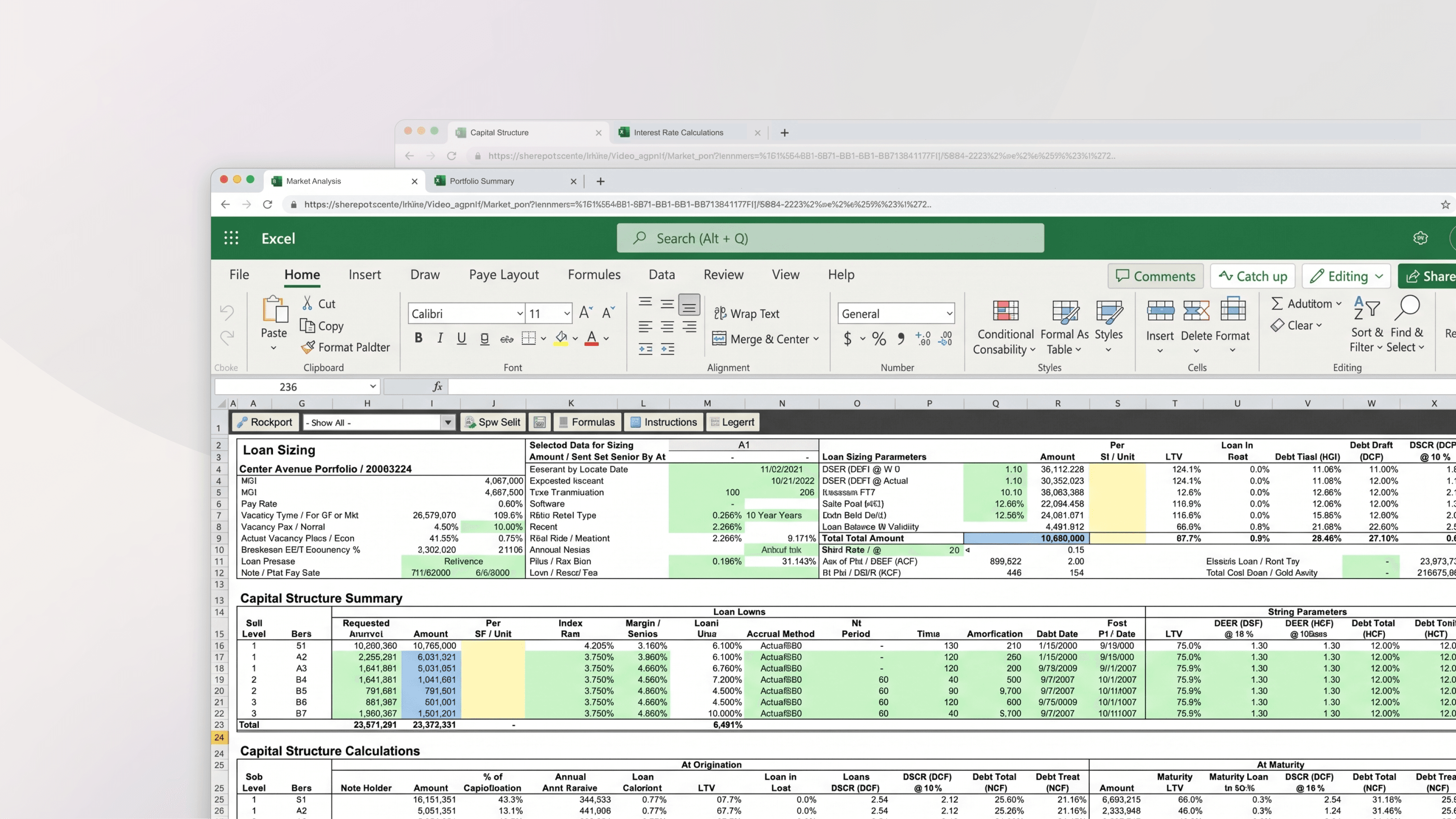
A lender with sixty loans and four years of clean books decides to move to a loan origination system. During the data migration, the implementation team asks a routine question: what interest calculation method are the DSCR loans configured for? The lender opens the spreadsheet. The formula is there. Nobody knows who wrote it or when. The answer is Actual/365. Yet, the product was supposed to run Actual/360.
It had been wrong for two years. Not by much on any individual loan. Enough, across sixty loans and twenty-four months, to matter.
That discovery — not the error itself, is what defines spreadsheet-run lending operations. The outputs look right. The payments come in. The books close every month. The error runs until something forces a comparison between what the portfolio was supposed to earn and what it actually collected. Usually that something is a payoff dispute, an investor audit, or a data migration that asks the wrong question at exactly the right time.
Why Spreadsheets Work at First — and Break Down at Scale
The appeal is real. Spreadsheets are free, flexible, and owned entirely by whoever built them. A lender closing five to ten loans a year with a single product type and no outside contributors can run an accurate operation on a well-built spreadsheet. The owner understands every formula, can verify every output, and catches problems before they propagate.
The architecture is not the issue at that scale. The issue is that spreadsheets are calculation engines, not operational systems. They do not enforce configuration. They do not flag when a formula has drifted. They do not alert anyone when a draw balance was not updated before interest ran. They execute whatever is in the cell and return a result that looks like an answer.
The research is consistent on this. A 2024 literature review by Professor Pak-Lok Poon in Frontiers of Computer Science — drawing on 35 years of studies — found that 94% of business spreadsheets used in decision-making contain errors. Raymond Panko at the University of Hawaii, synthesizing field audits of real-world spreadsheets over the same period, found that 88% of audited spreadsheets contained errors. These are not studies of careless operators. They reflect the structural reality that spreadsheet accuracy depends entirely on sustained human discipline — and that discipline degrades as complexity grows.
In private lending, complexity grows quickly. A second product type means a second interest configuration. A second contributor means a second person updating draw balances and payment records. A loan modification means a manual recalculation that may or may not get done correctly. Each of those conditions is manageable in isolation. Together, across a portfolio of 50 or 80 loans, they create a system where errors can persist for months before anyone asks the question that surfaces them.
Five Categories of Hidden Cost in Spreadsheet-Run Lending Operations
The comparison most lenders make is straightforward: spreadsheets are free, software costs money. That framing counts only one side of the ledger. It ignores five categories of cost that spreadsheet-run operations pay consistently — most of which are invisible until a specific event forces them to the surface all at once.
1. Interest Calculation Configuration Drift — The Yield Gap No One Audits
Private lending most commonly uses three interest calculation methods: 30/360, Actual/365, and Actual/360. Each produces different results at the same stated rate, and each is the correct choice for specific products and purposes. A lender who has made a deliberate decision about which method to use and applied it consistently across their portfolio is doing exactly what they should. The spreadsheet problem is not which method a lender chooses. It is whether that choice is actually being enforced.
In a purpose-built loan origination system, the interest calculation method is configured at the product level. Every loan originated under a given product inherits that configuration automatically — it cannot drift between originations or change because someone edited a formula. In a spreadsheet, the configuration lives in a cell. If that cell was set incorrectly when the spreadsheet was built, every loan calculates wrong from the start. If it was modified later by someone who did not understand its downstream effects, every loan originated after that modification calculates wrong from that point forward.
The yield gap this creates is not hypothetical. On a $10,000,000 portfolio at 8%, a single day count misconfiguration — Actual/360 where the product calls for Actual/365, or vice versa — produces a difference of approximately $11,111 in annual interest. That number does not appear on any individual loan statement. It surfaces only when someone compares projected yield against what the portfolio actually collected. Most lenders on spreadsheets never run that comparison until something forces it.
The problem compounds when a portfolio spans multiple product types configured differently. A DSCR product and a fix-and-flip product running on different day count bases — not because that was the intention, but because the spreadsheet was modified at different times by different people — creates a reconciliation problem that is difficult to diagnose and time-consuming to correct.
2. Per Diem Errors — The Irregular Period Nobody Checks
Per diem interest is the daily rate applied to periods that fall outside a standard monthly billing cycle. It applies at loan opening when a borrower closes on a date other than the first of the month, at payoff when a borrower repays before their next scheduled due date, and on newly released draw amounts when a construction or fix-and-flip disbursement occurs mid-period.
In a well-configured loan origination system, per diem is calculated automatically, derived from the same day count basis configured at the product level. In a spreadsheet, it is typically calculated manually — or estimated — or handled inconsistently depending on who is running the closing or processing the payoff.
Because per diem calculations are irregular by definition, they are the least likely part of a lending operation to be audited. Lenders review their payment schedules. They rarely look at whether per diem was calculated correctly on the 47th closing or the 12th payoff of the year. That is precisely where small but persistent errors accumulate without surfacing — until a payoff reconciliation or a borrower question forces someone to check the math.
3. Construction Draw Tracking — Where Balances Drift and Disputes Start
Fix-and-flip and construction loans carry a draw component: capital released in stages as renovation or construction progresses. Under the non-Dutch method — standard in private lending — interest accrues only on funds that have been disbursed. On a $500,000 commitment where $200,000 has been released, interest accrues on $200,000 only. When a new draw is released mid-period, per diem interest on that disbursed amount accrues for the remaining days in the period.
In a purpose-built platform, this is enforced at the product level. In a spreadsheet, every draw disbursement requires a manual update to the outstanding balance before the interest calculation runs. One missed update produces the wrong balance. The wrong balance produces the wrong interest charge. If the error is not caught before the next draw, it carries forward into the next period.
Draw errors are disproportionately common in spreadsheet-run operations because draw management is the highest-frequency, most manual-intensive process in the workflow. Each disbursement requires a coordinated update across the outstanding balance, the interest accrual, and the draw budget. That sequence depends entirely on the person running it doing it correctly, in the right order, every time. The error does not announce itself. It shows up at payoff, when the system balance and the borrower's expectation do not match — and that is when the dispute starts.
4. Loan Modifications — The Split-Period Calculation That Often Gets Skipped
When a loan is modified mid-period — a rate change effective on the 15th, a principal adjustment on the 22nd — the billing period splits. Interest for days before the modification date accrues at the original terms; interest for days after accrues at the new terms. The total charge for that month is the sum of both portions. The amortization schedule then regenerates from the modification date forward using the updated terms.
In a loan origination system, this recalculation is automatic. In a spreadsheet, it is a manual calculation — and it is the step most likely to be skipped or approximated when a modification is processed under time pressure. A lender who updates the rate in the spreadsheet without recalculating the split period carries a wrong amortization schedule forward from that date. Every subsequent payment is calculated against an incorrect baseline. The error is small in any individual period, but it compounds through the remaining loan term.
The gap between the scheduled remaining balance and the actual remaining balance becomes visible at payoff. By that point the discrepancy has to be reconciled manually, often under time pressure, which is an operationally expensive outcome for what was originally a routine modification.
5. Operational Overhead — The Labor Cost Most Lenders Have Never Calculated
The first four cost categories are yield-related — money that should have been collected but was not, or errors that produce disputes at the worst possible moment. The fifth is different: it is the labor that a spreadsheet-based operation absorbs, and it is the cost most lenders have never quantified because it does not appear as a line item anywhere.
A 2026 survey of 1,003 US operations professionals by DOSS found that teams spend an average of 3.6 hours per week fixing spreadsheet errors — equivalent to more than 22 full workdays per year, per employee. That figure covers error correction only. It does not include time spent building reports from raw data, reconciling files that have diverged, generating payoff statements manually, or answering borrower questions that a self-service portal would have handled without staff involvement.
At a loaded rate of $48 per hour — conservative for a private lending operation — 3.6 hours per week of error correction costs approximately $8,986 per employee per year. That is before reporting, reconciliation, and manual payoff work are added. It is also before the cost of a single material error: the same DOSS survey found that a significant spreadsheet error costs an organization an average of $4,315 per incident. Scale that figure to your team size and compare it to the annual subscription cost of a purpose-built platform. The labor overhead alone typically exceeds what most private lending platforms cost.
At What Portfolio Size Do Spreadsheets Become a Liability?
There is no universal threshold, but the operational friction typically becomes significant between 20 and 50 loans. Below 20, a single owner can manually verify most outputs and catch errors before they compound. Above 50, the combination of multiple product types, multiple contributors, and high-frequency draw and payment activity creates enough complexity that manual verification is no longer a reliable control.
The comparison most lenders make — spreadsheets are free, software costs money — counts only the subscription price. It leaves out the labor absorbed in error correction, the yield lost to misconfigured calculations, and the cost of disputes that could have been avoided. The subscription cost appears on a monthly statement. The spreadsheet cost is distributed across team hours and uncollected interest, which is why the comparison feels lopsided in the spreadsheet's favor until the math is actually run.
Most purpose-built private lending platforms for operators at the 20-to-200 loan range are priced between $300 and $1,500 per month. At 3.6 hours per week of error-correction overhead per employee, a two-person operation is spending roughly $17,972 per year in labor alone on spreadsheet maintenance — before any yield gap or error incident is counted. For most operators at that scale, the labor cost alone is in the same range as the annual software cost. Add the yield gap and the error incidents, and the comparison resolves clearly.
The question is not whether a lender can afford software. It is how long they can afford to operate without it.
What "Correct Configuration" Means — and Why Spreadsheets Cannot Enforce It
The deeper risk with spreadsheet-run lending is not that errors happen. It is that lenders often do not know which configuration they are running.
A purpose-built loan origination system enforces configuration at the product level. The interest calculation method, day count basis, amortization type, and draw structure for each product are set once, documented in the lender's credit policy, and reflected exactly in the system. Every loan originated under a given product inherits those settings automatically. They cannot drift between originations or change because a formula was edited.
A spreadsheet does not enforce configuration. It executes whatever formula is in the cell. If that formula has drifted from the intended configuration — through an edit, a copy-paste error, or a modification made by someone who did not fully understand its downstream effects — the system produces wrong outputs without flagging the problem. The lender does not know because the outputs still look plausible. The error accumulates.
A lender running on a purpose-built platform does not face that uncertainty. The configuration is set once and enforced automatically. The comparison between projected yield and actual yield is one they can run at any time — because they already know what the answer should be.
Frequently Asked Questions
How many loans does it take before spreadsheets become a liability?
The friction typically becomes significant between 20 and 50 loans. Below 20, a single disciplined operator can manually verify outputs and catch errors before they compound. Above 50, the combination of multiple product types, multiple contributors, and high-frequency draw and payment activity creates enough complexity that manual verification is no longer a reliable control. The threshold varies by product mix — a lender running a single interest-only product type will hit it later than one managing DSCR, fix-and-flip, and construction loans simultaneously.
What is the most common spreadsheet error private lenders make?
Interest calculation misconfiguration — specifically, a day count basis applied inconsistently across loan products, or set incorrectly in the foundational formula and never subsequently audited. Because the error produces outputs that are plausible rather than obviously wrong, it persists longer than errors that fail visibly. Per diem calculation gaps are the second most common, for the same reason: they are irregular by nature and rarely reviewed in isolation.
How much does private lending software actually cost?
For operators managing between 20 and 200 loans, most purpose-built private lending platforms are priced between $300 and $1,500 per month, depending on loan volume, included modules, and whether servicing, borrower portal, and investor management are bundled or sold separately. The monthly rate is rarely the full cost — implementation, data migration, training, and per-loan pricing at scale can shift the total significantly. Request a 36-month projection at your current and anticipated loan volume before comparing monthly rates.
Is migrating from spreadsheets to an LOS difficult?
For most private lenders, migration from spreadsheets is primarily a data preparation exercise: organizing current loan balances, interest method configurations, amortization schedules, and draw histories for import. Most platforms in the private lending space are designed for self-service implementation. The primary variable is the quality of the existing spreadsheet data — lenders with clean, consistent records migrate faster than those with inconsistent historical configurations. Validating outputs after migration, particularly comparing amortization schedules against the spreadsheet, is the step most worth investing time in.
Can a spreadsheet be accurate if it is well-built?
Yes, within limits that are easy to underestimate. A well-built spreadsheet managed by a single disciplined operator with a small, uniform portfolio can be accurate. The problem is that most private lending operations are not static — they grow, add product types, add contributors, and change loan terms. Each of those changes is an opportunity for a well-built spreadsheet to become one that is no longer correctly maintained. The accuracy of a spreadsheet is a function of sustained discipline applied consistently by everyone who touches it. For a business processing millions of dollars per year across dozens of loans, that is a fragile foundation.
How Baseline Handles Loan Product Configuration
Most of the yield leakage and operational overhead described in this article does not come from bad pricing or weak deal flow. It comes from loan products that were never configured correctly in the first place — and portfolios that have been running on those settings ever since. The lender does not know because no single loan looks obviously wrong. The error only becomes visible when you step back and compare what the portfolio was supposed to earn against what it actually collected.
Baseline builds loan product configuration into the origination system so that every loan inherits the correct interest method, day count basis, amortization type, and construction draw settings from day one. No manual entry per loan. No drift between origination and servicing.